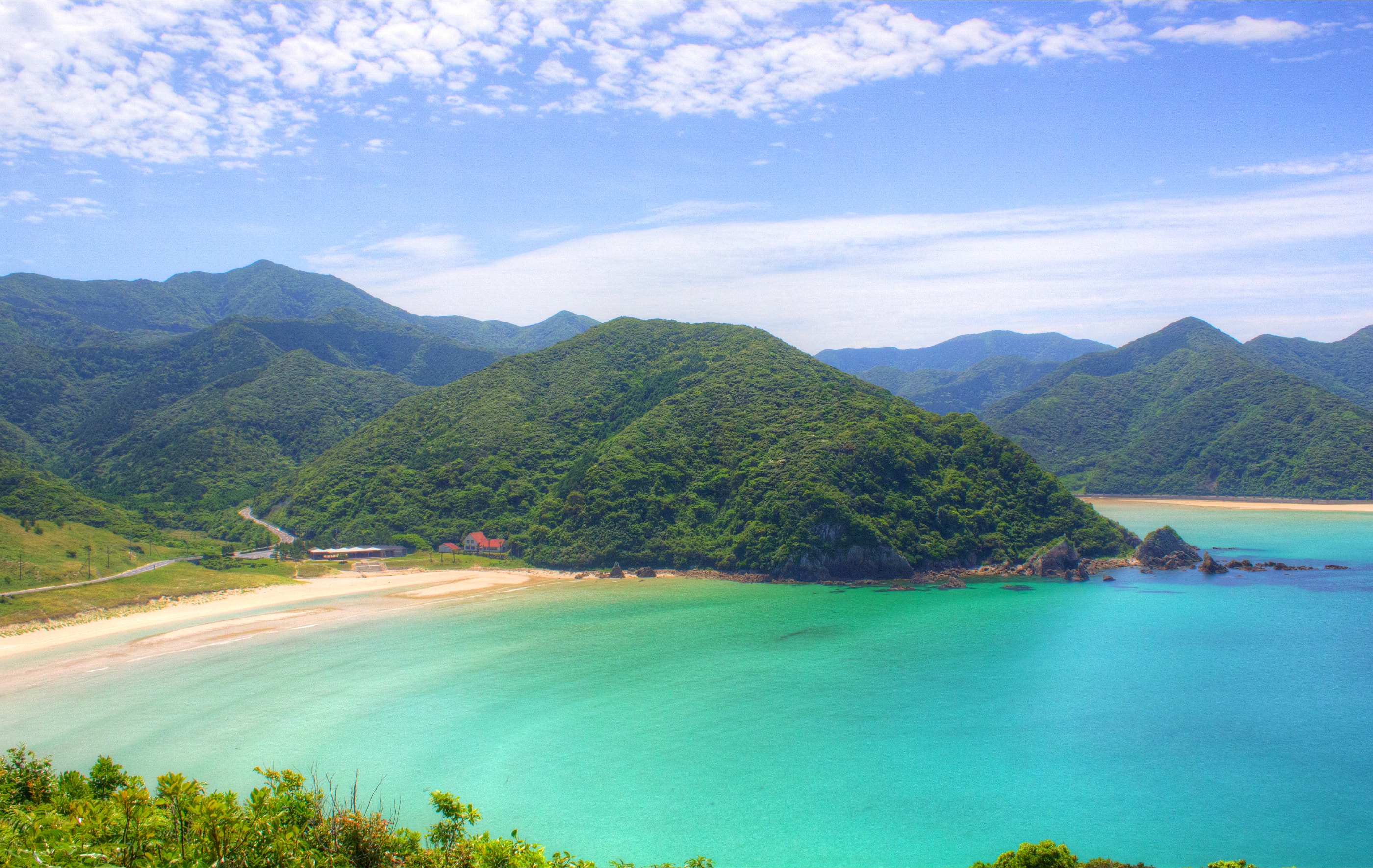
Theme 01| Encounter “Another Story of Japan” on a Quiet Island
The Hidden Christian Heritage of the Goto Islands
Across the islands of Goto, there remain forms of prayer that have been quietly passed down through the centuries.
By walking slowly through churches and village communities, visitors can calm their minds, reflect inwardly, and experience a gentle, contemplative island time.
The Hidden Christian Heritage of Goto
Three Key Attractions
-
A Christianity Unique to Japan
During the Edo period, Christianity was banned in Japan, and many believers were unable to practice their faith openly.
In Goto, people continued to protect their faith by incorporating elements of Buddhism and Shinto as a form of camouflage, allowing belief to survive within everyday life. Through this history, a rare form of Christian culture unique to Japan emerged—found nowhere else in the world.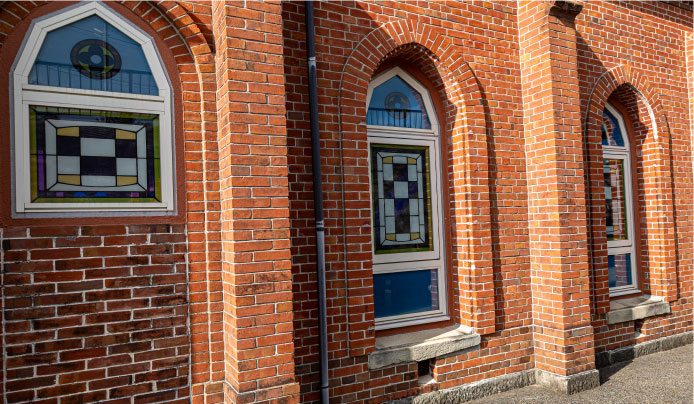
-
Churches Standing Between Sea and Mountains
Many of Goto’s churches were built using Western church styles, but constructed with traditional Japanese wooden carpentry techniques.
Their presence—blending seamlessly with the sea, mountains, and village landscapes—creates church scenery that can only exist here, shaped by Japan’s natural environment and history.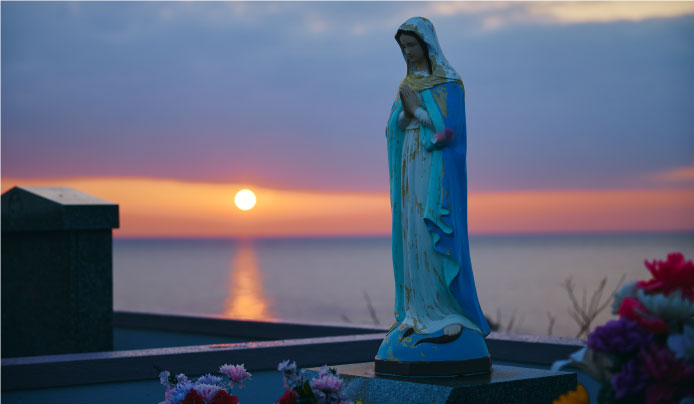
-
Island Landscapes Discovered Through Church Pilgrimage
This journey is not only about visiting churches. Along the way, travelers stop at ocean-view hills, quiet villages, and scenes of everyday island life.
With each step, you encounter landscapes that invite you to pause and take photographs, and while breathing in the unique air of a remote island, you enjoy a Japanese island experience at your own pace—calm, unhurried, and deeply personal.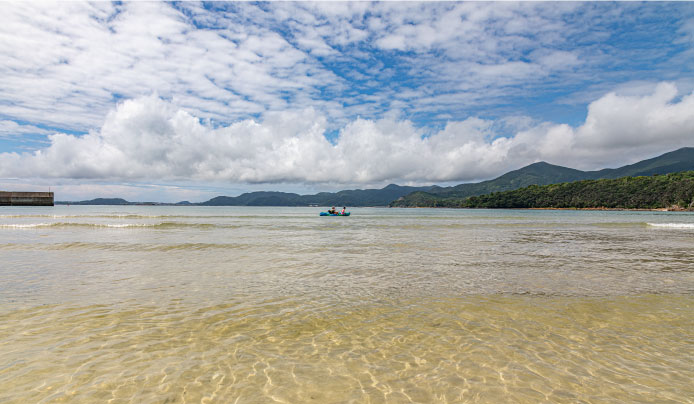
Suggested Route
A Journey Through the History of Prohibition and the Island’s Sacred Landscapes
On the Goto Islands, especially on Fukue Island, you can travel around the island while tracing the stories of people who were once denied the freedom to practice their faith.
The persecution of Christianity, which began on Kuga Island in the northern Goto Islands, eventually spread to Fukue Island.
In the less visible southwestern areas of the island, people quietly and steadfastly continued to protect their faith. Their prayers were not confined to special sacred places—they have been passed down as part of everyday life.
Even in the northern regions, where persecution was most severe, faith never disappeared. The churches that became spiritual anchors under the prohibition edicts still quietly convey the strength and endurance of the people of that time.
And in the northeastern part of the island, churches remain that were built in an era when prayer was once again permitted freely. There, one can feel the relief and joy of people who endured long years of hardship, as well as the hope that points toward the future.
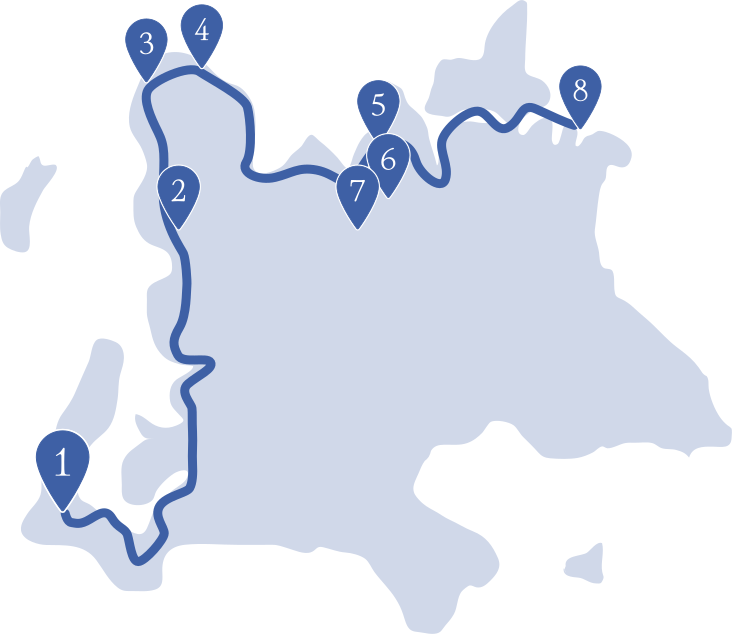
Suggested Route
〈 Hidden Faith〉
Imochiura Church
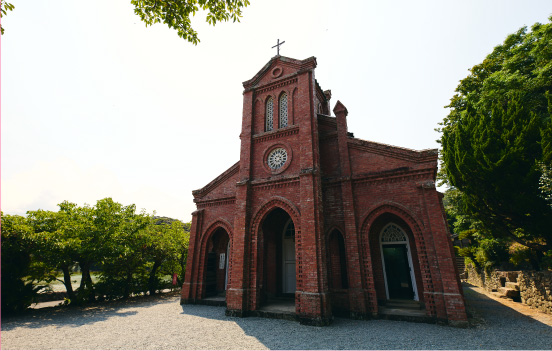
Imochiura Church is a place where Hidden Christians took refuge during the severe anti-Christian policies of the Edo period, becoming the only community that successfully escaped persecution and preserved their faith. It is the first brick-built church in Goto, and features the “Lourdes Grotto (Grotto of the Apparition of the Virgin Mary),” said to have been constructed using rocks and rare stones gathered from across the Goto Islands. This unique site expresses a distinctly Goto-style church landscape and continues to attract pilgrims from many regions.
Visiting hours:9:00~17:00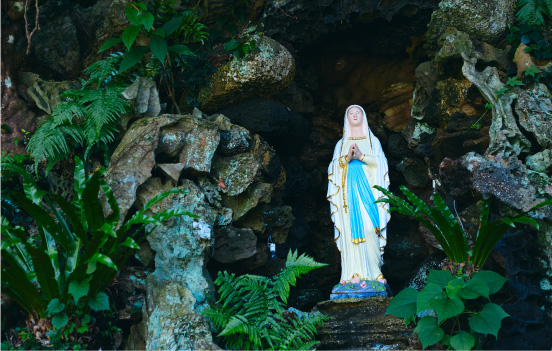
〈 Daily Life〉
Kaizu Church
Kaizu Church is known as a place where visitors can experience the “art of light” created by beautiful stained glass. The warm light that filters through stained glass handmade by local residents creates a gentle atmosphere, bringing a sense of inner peace within the sacred space. Built in a community where believers once lived quietly after migrating to escape persecution, the church features no lavish decoration. Instead, it is a wooden church that exists as a natural extension of traditional Japanese living spaces, expressing a uniquely Japanese sense of sacred architecture.
Visiting hours:9:00~17:00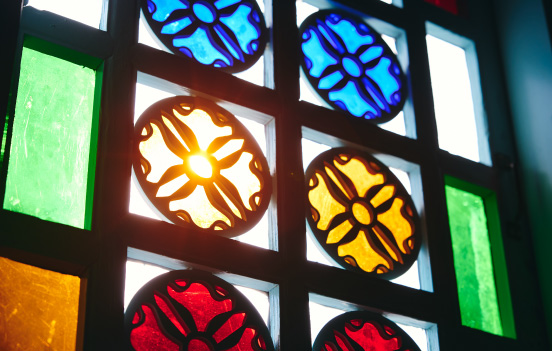
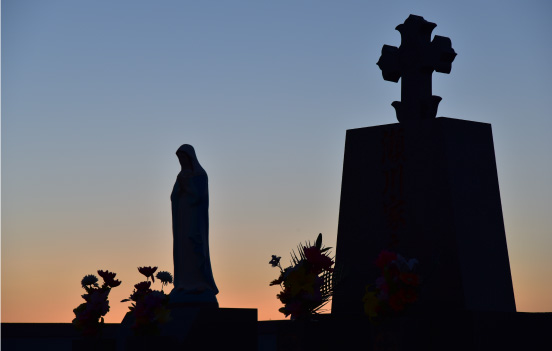
Fuchinomoto Catholic Gravestone Group
The Fuchinomoto Catholic Gravestone Group quietly conveys how the faith of the Hidden Christians remained deeply rooted in life even until death. Statues of the Virgin Mary and the style of the gravestones differ from typical Japanese cemeteries, preserving the deep spirituality of the Hidden Christians to this day. Located on elevated ground overlooking the sea, the site offers panoramic views of the East China Sea, allowing visitors to enjoy a vast ocean landscape despite being within a cemetery.
〈 Persecution〉
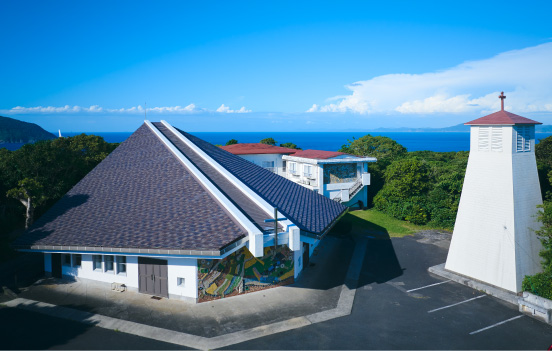
Miiraku Church
Miiraku Church was built in one of the regions of the Goto Islands with the longest history of Hidden Christianity. Its design, developed uniquely in Goto, can only be seen at this church. The vividly colored stained glass is breathtaking, depicting the history of Catholicism in Goto and the life of Christ—from His birth to His resurrection. The adjacent museum allows visitors to learn about life during the harsh persecution era, as well as the region’s whaling history and the daily lives of people who lived together with their faith.
Mizunoura Church
Mizunoura Church is a place where the beauty of wooden architecture in harmony with Goto’s natural environment truly stands out. Blending Romanesque, Gothic, and Japanese architectural styles, it is one of the largest wooden church buildings in Japan. Its elegant white structure contrasts beautifully with the blue sky and sea, captivating all who visit. The site preserves remnants of persecution history, including a prison from the persecution era and a statue of St. John Goto, one of the Twenty-Six Martyrs of Japan, allowing visitors to learn about the Christian history of Goto.
Visiting hours:9:00~16:00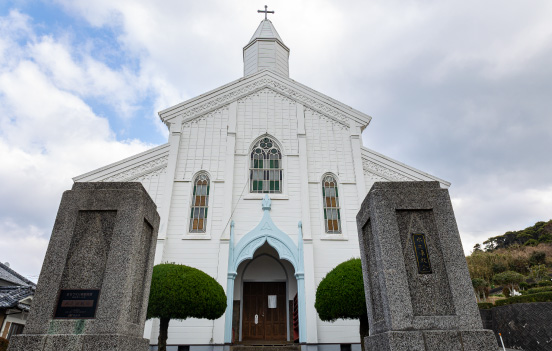
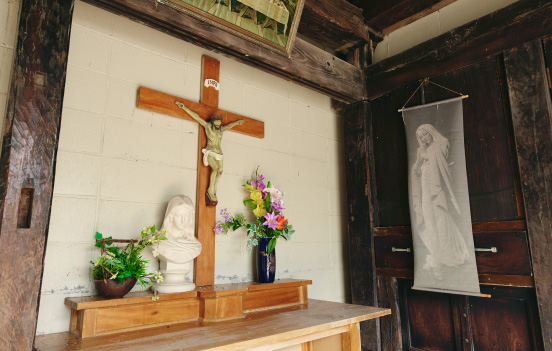
Kusuhara Prison Ruins
The Kusuhara Prison Ruins commemorate the events of the “Goto Collapse” (1868), when believers were arrested—an incident that marked the beginning of large-scale Christian persecution in Goto. This site reconstructs the prison used in the early Meiji period for persecuting Christians. At the memorial monument, the “Statue of Prayer,” prayers are offered so that such tragedies may never be repeated, passing this message on to future generations.
Kusuhara Church
Kusuhara Church is the second-oldest brick church on Fukue Island. When visited together with the nearby prison ruins, it allows visitors to experience the story of Goto’s transition from persecution to restoration in a vivid, three-dimensional way. Built in an area first cultivated by early Christian settlers, the church reflects both the lives of residents who once disguised themselves as Buddhists and the history of persecution. The vast interior space, crowned by a rib-vaulted ceiling, is deeply impressive. Palm trees planted at the church entrance create a distinctive scene where Goto’s natural landscape meets sacred architecture.
Visiting hours:9:00~17:00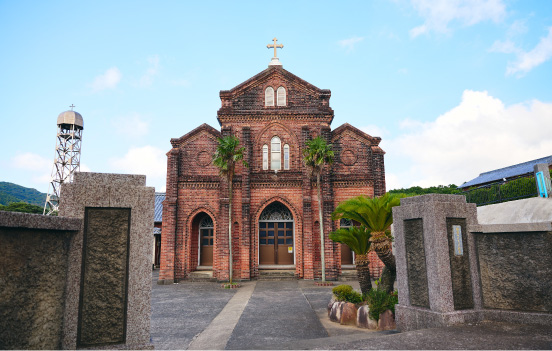
Dozaki Cathedral
Dozaki Cathedral is a brick church standing quietly by the sea and serves as a symbolic site for learning the Christian history of the Goto Islands systematically. It was the first church built in the Goto Islands after the ban on Christianity was lifted, marking the restoration of Christian faith in the region. On the shoreline in front of the cathedral, visitors can also view the twin round stones known as “Apple Stones,” naturally formed by the unique geology of the Goto Islands. As a symbol of the liberation of faith, the church conveys the joy of prayers once suppressed now being released, along with hope that extends into the future.
Tours to Experience the History of the Hidden Christians
Fukue Island Scheduled Sightseeing Bus Tour
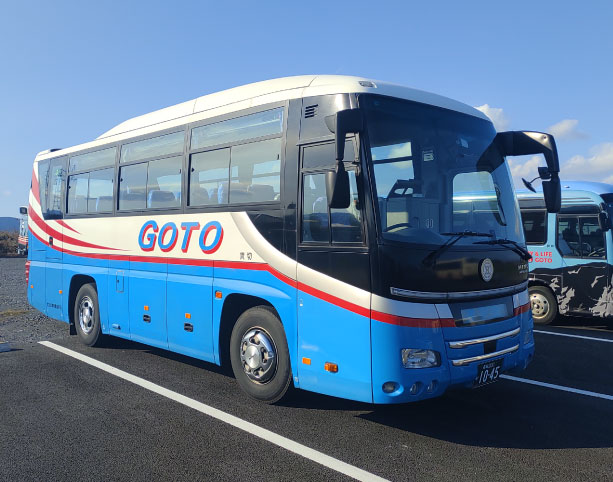
On Fukue Island, there is a sightseeing bus tour that allows visitors to experience both the island’s rich natural environment and the quietly preserved history of Christianity at the same time. Following the traces of churches and places of prayer that remain on the island, travelers can feel the passage of time lived by past generations, surrounded by the island’s calm and gentle atmosphere. Along the route, the tour also stops at scenic viewpoints where the vast ocean can be seen up close, offering expansive coastal landscapes unique to Goto. This is a journey where you encounter history, are embraced by nature, and step slightly away from everyday life — a tranquil island experience that gently restores the mind and spirit.
Learn MoreFukue Island Private Taxi Tour

On Fukue Island, one way to explore the island is through a private taxi sightseeing experience. After selecting your preferred route, you can travel in comfort, leisurely enjoying the distinctive landscapes of Goto—where the sea and mountains are always close at hand. Without being rushed by schedules or constant transfers, you move at a calm, relaxed pace, experiencing a more refined and personal journey through Goto—one that offers a depth and intimacy very different from group travel.
Learn MoreFrequently Asked Questions
-
Can I enjoy this experience even if I’m not familiar with the history of the Hidden Christians?
-
How should I travel along this route?
-
Are there any manners or rules to observe when visiting churches?
-
Is there any dress code to be aware of?
-
Can non-believers pray or attend Mass (worship services)?
-
Is photography allowed?
-
Is there an entrance fee to visit the Hidden Christian heritage sites?
-
Is there anything special I need to bring when visiting?
-
Can I use the restrooms at the churches?